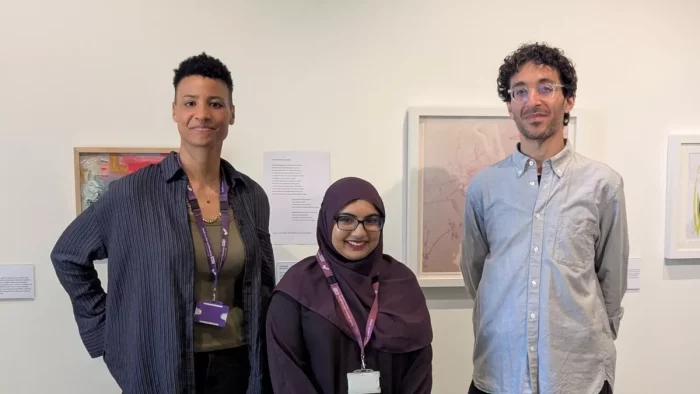
Jess Murrain has been our 2026 London Writer In Residence. Jess is a queer, interdisciplinary creative of British-Caribbean heritage, working in live art, theatre, film and poetry. She is also the co-founder/Artistic Director of Art Wife, an experimental live art company, whose latest project, NEUROQUEER, was commissioned by Bradford 2025 City of Culture. She is the winner of the Ledbury Poetry Prize, Out-Spoken Prize in Poetry and Film, and a Creative Future Writers’ Award.
Jess’ residency took place in London in collaboration with Bethlem Gallery.
I first encountered Bethlem Gallery in 2023, when I was invited to lead writing workshops with Bethlem Writers’ Collective. I arrived at a time when my own heart felt quite obliterated by grief and personal upheaval. What I rediscovered in Bethlem Gallery was the restorative power of artistic community: writing and teaching alongside practising artists and poets, on a weekly basis, felt deeply healing in ways I didn’t consciously anticipate.
The workshops encouraged me to revisit questions that underpin my own practice: What role does collective care play in healing from heartbreak, marginalisation and trauma? How do we carry forward the voices of those who came before us? What can collaborative artistic practice contribute to a more equitable society where creativity and mental health are intricately linked? My journey at Bethlem began with these questions and continues because of them.
Returning in 2026 as Writer In Residence allowed me to deepen this understanding, and strengthen the notion that the relationship between art and mental health is not theoretical, but deeply embodied and human. Writing became less about producing polished work and more about showing up authentically, and finding one another on the page and in voice.
I have also been fortunate enough to work alongside the brilliant artist and illustrator Angel Curniffe, who shadowed and supported my writing workshops. Angel and I are both Black, neurodivergent artists, and it felt important to use this residency to create an opportunity for an emerging practitioner. Access to the arts, particularly for young, working-class Black creatives, is still frustratingly limited—and barriers to opportunity are increasing. The gatekeepers of the money, the space, the commission, the idea, are alive and sadly still kicking, so creating opportunity for collaboration and mentorship in such an inclusive environment really matters.
 Working at Bethlem was also liberating for me. Its culture cuts through middle-class sensibilities that often dominate cultural spaces, and it offered rare freedom from the white gaze that determines how I occupy space elsewhere. I was given the time and trust to be fully present; to take up space and not minimise myself or my experience. At Bethlem, the political and the personal are inseparable, and personhood is always centred, no matter the journey you’re on.
Together, Angel and I delivered four workshops with the Writers’ Collective. Poetry provided the starting point, with each session exploring a different creative approach. One week we focused on poetic form, inspired by Jericho Brown’s invention of ‘The Duplex’. Rather than treating form as a set of inherited rules, writers invented forms of their own, creating structures that reflected their individual styles. One writer, whose practice is rooted in dance and chorography, combined breath, movement and syllabic rhythm count to when experimenting with form.
Another workshop explored ‘remix’ as a theme. Participants reworked existing poems, sampling and reshaping language much as DJs/musicians sample old tracks. Remix became a symbol of engaging with Bethlem’s archive too—collaging voices from existing poems/poets and poets gone by, while creating something entirely new. It reminded me that writing is never isolated; it exists within histories of influence and collective memory.
One of the greatest strengths of Bethlem is also the trust that already exists within its established community and collectives: an atmosphere free from pretension, fragility or guise. As a facilitator, I feel able to take more risks because of the honesty that permeates the workshops.
Also, the intergenerational nature of the collectives, combined with their generosity, curiosity and grassroots spirit, make it one of the most creatively expressive environments I have worked in.
The writers suggested a session on performance; as a trained actor and live artist, I know that performing is nerve-wracking and confronting, and since a deeply trusting atmosphere is needed, I saved a session on spoken word poetry and public speaking until last. Watching writers share their own poems, words, experiments and songs was wonderful to witness; it remains one of the highlights of the residency. It takes huge courage to share our own work. It’s the opposite of cynicism as it relies on vulnerability and collaboration. I never take moments like this for granted as a facilitator; seeing students go outside of their comfort zone and fly was a humbling experience.
Meanwhile, discussion on the Gallery’s archive was also robustly unpicked and delved into with the Bethlem Artists Collective. We looked at poetry by Jay Bernard, from their poetry collection ‘Surge’ and the work of photographer, painter and visual artist Darrel Ellis—both of whom I feel work specifically with archival-based processes that dance around elusive and rich materiality. The group reminded me that archival process (by its nature a very creative one) is working with peoples lived experienced, history, testimony and words with care. The artist can bear witness and can also give voice to those whose agency may not have been valued in their original context and time. So, as I posed questions about how we might ethically work with voices from the past, and the voices of the dead—interweaving and integrating their histories and allowing the archive to inform our art practise and archival projects—I was reminded that we as artists and writers have great privilege when working with words and language. It is through research, this process based ‘scouring’ (perhaps delving?), that creative potential arises. This is a deeply empathic and radical act, and the artists helped me analyse this from a new perspective.
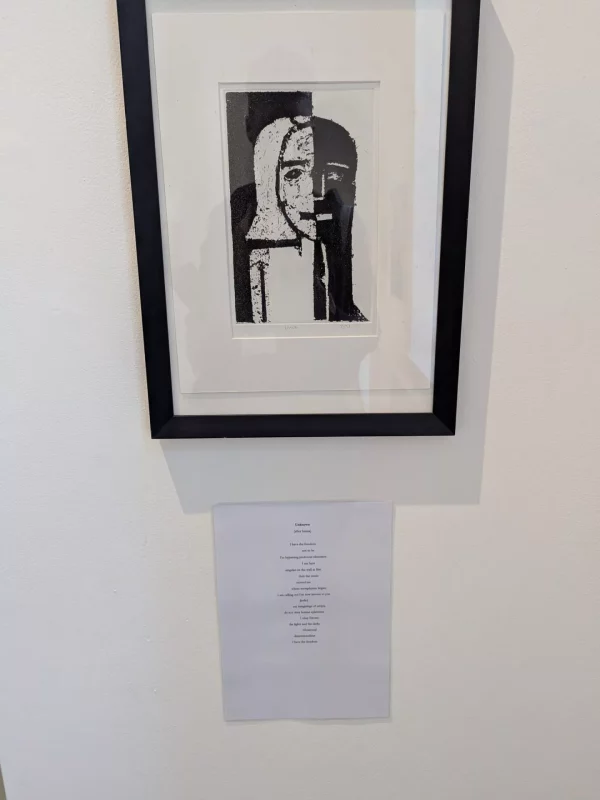
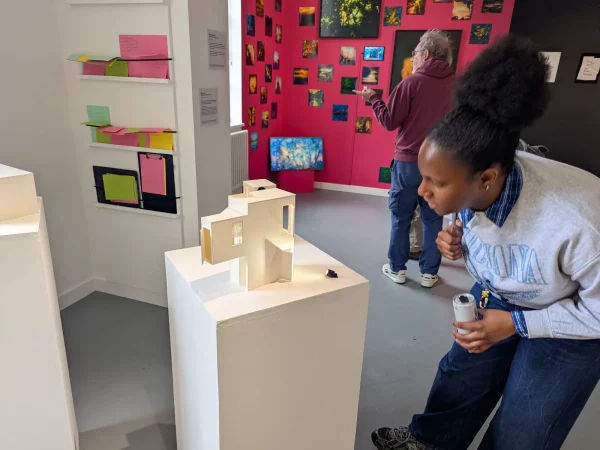
I’ll conclude where I began my residency, as ‘exhibition poet’ for The Places We Know, curated by Karim Sultan and Bethlem artist and writer Halimah Zakiuddin. I was invited to respond poetically to the artworks and the artists and in some way interrupt or subvert the authorial ‘gallery voice.’ I mainly worked with an ekphrastic process when writing the poems. I also created two sound pieces (which I did using my voice and a loop pedal) in response to two of the artworks. You can read more about this here and listen to the sound pieces below—they are in response to ‘Enthesitis’ by Antonia Attwood and ‘Isabella Dances’ by Jan Arden:
A final thought on imposter syndrome (which we know disproportionately affects those who’ve been excluded from ‘mainstream’ cultural spaces). Above all else, my role as resident writer was less that of ‘teacher’ and more that of hypeman to eradicate these invasive feelings…someone to advocate, encourage and engage writers/artists to trust their instincts and follow threads that galvanise them. This was reciprocal: I don’t have a formal education in poetry, and one of the greatest gifts of this residency has been working alongside these artists, who share a similarly grassroots, DIY approach to their practice. They’ve made me feel braver and more empowered as an artist.
I leave this residency not only with new poems but with renewed faith in the power of creative community, and in the power of punk in the face of the establishment. I feel incredibly honoured to have been part of it.
(Huge thanks (in particular) must go to Creative Future, and curator and artist Karim Sultan for his care, time and collaboration on the entirety of this residency.)